

Imagine a married couple living together in Dubai. One partner is British and has been working for a UAE company for several years. They have decided to move to the UK, and at first the immigration side sounds straightforward: provide the marriage certificate, complete the form and arrange the flight.
Then the questions begin.
Whose salary counts? Can the British spouse keep using their Dubai income? Do they need a UK job before applying? What happens if they resign too early? Can the couple use savings? How recent do the bank statements need to be? And where does the applicant actually give biometrics?
Those details are why a UK spouse visa from Dubai often requires more planning than couples expect.
“Spouse visa” is the phrase most applicants use, although GOV.UK officially deals with spouses and partners under the family visa route. The underlying rules are set by the Home Office, and UK Visas and Immigration (UKVI) makes the application decision.
This guide was researched against current official material on 22 September 2026. Immigration rules and charges can change, so check the live government guidance again before submitting an application.
UK spouse visa from Dubai: The Short Answer
Yes. A person living in Dubai can apply from the UAE to join a qualifying spouse or partner in the UK, provided the relevant relationship, sponsor-status, financial, English-language and other requirements are met. For most new partner applications, the current minimum income requirement is £29,000, although exceptions and transitional rules exist. A British or settled sponsor does not necessarily have to move back to Britain months before the application: special rules can allow qualifying overseas earnings to be considered when that sponsor is returning to UK employment. The evidence and timing rules are critical.
Who Can Apply for a UK Spouse Visa from Dubai?
For the standard partner route, both partners normally need to be at least 18. The UK partner must have an eligible immigration status, and the couple must intend to live together permanently in the UK.
| Requirement | What It Usually Means | UAE/Dubai Planning Point |
| Qualifying UK partner | Common examples include a British or Irish citizen or someone settled in the UK; certain other listed statuses can also qualify | Confirm the sponsor’s exact status before building the application around the family route |
| Qualifying relationship | A marriage/civil partnership recognised in the UK, or another qualifying partner relationship under the rules | UAE and overseas civil-status documents may need clear supporting evidence and translation |
| Genuine continuing relationship | The couple must show a genuine relationship and an intention to live together permanently in the UK | Couples already living together in Dubai can use coherent shared-residence and financial evidence |
| Financial requirement | Usually £29,000 for a new partner application unless an exception or transitional rule applies | Overseas sponsor income needs to be assessed under the correct category before resignation or relocation |
| English | Normally A1 for an initial family entry-clearance application if using a test | Book only an approved test/provider where a test is actually required |
| Accommodation | Adequate accommodation must be available without creating prohibited overcrowding or similar problems | Decide where the couple will initially live in the UK and gather appropriate evidence where needed |
Eligibility and relationship rules:
Who the UK Partner Must Be
Common qualifying sponsors include a British or Irish citizen or a person who is settled in the UK, such as someone with indefinite leave to remain. GOV.UK also lists several other qualifying categories, including certain people with pre-settled status or protection status.
This status check matters because a family visa is not simply “the visa for anyone whose spouse is in Britain.” If your partner is temporarily in the UK on a work or student visa, GOV.UK says you generally cannot use the family visa on that basis; the appropriate route may instead be a dependant route attached to that person’s immigration permission.
Bloom Global also publishes separate information on Skilled Worker Visa support where that distinction is relevant.
Relationship Requirements
For a married applicant, the marriage must be recognised in the UK. The rules also cover civil partners and certain unmarried partners. Both partners must intend to live together permanently in the UK.
A marriage certificate proves the legal event, but it is not always the whole relationship story. GOV.UK’s examples of relationship evidence include shared addresses, joint finances and other official correspondence. Where couples cannot live together, the guidance looks at evidence of their ongoing commitment.
For a couple already sharing a Dubai home, this can make the evidence easier to organise: tenancy documents, household correspondence and joint financial records can create a coherent timeline. Quantity is less useful than consistency.
What Changes When You Are Applying from the UAE?
The substantive UK family rules do not become a separate “Dubai spouse visa” rulebook. What changes is the evidence context.
You may be working for a UAE employer, receiving salary in dirhams, holding savings in a UAE bank and living under UAE residence permission. If the UK sponsor is also employed in Dubai, the application may need the special returning-sponsor provisions rather than the ordinary UK-employment calculation.
For entry clearance, the general Immigration Rules say most applications must be made through a designated post in the country or territory where the applicant is living. That makes evidence of lawful UAE residence a sensible document to keep available where relevant.
What Is the UK Family Visa Financial Requirement?
The UK family visa financial requirement for most new partner applications is currently a minimum income requirement of £29,000 a year. Different rules can apply where the qualifying sponsor receives specified disability or carer benefits, and transitional rules exist for certain people who entered the partner route before 11 April 2024.
The tricky part is not simply remembering £29,000. It is proving that figure using a permitted financial source, the correct calculation period and the exact evidence prescribed for that source.
Employment Income
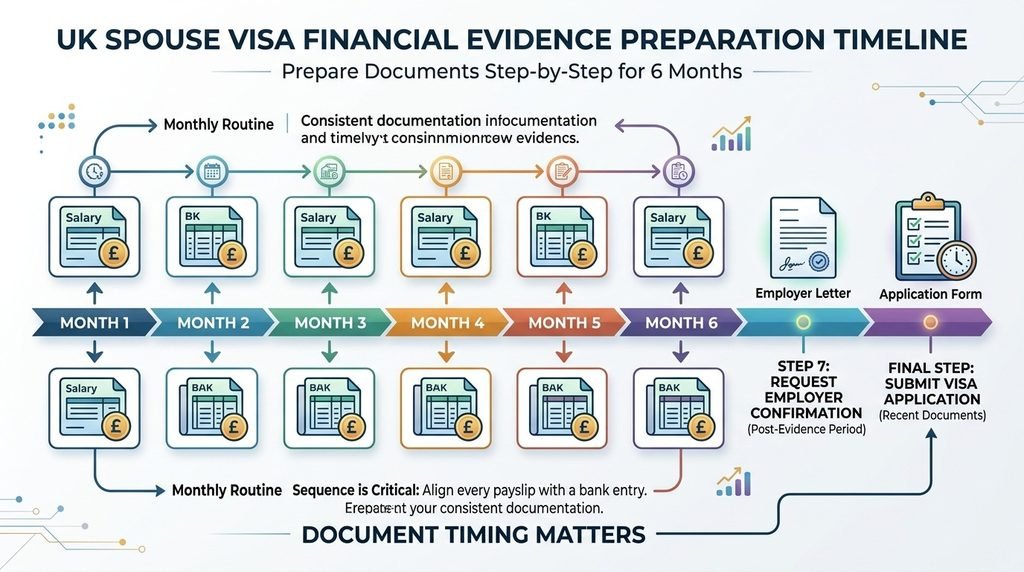
A sponsor already living and working in the UK will often rely on salary or non-salaried employment. The specified-evidence rules typically require payslips, corresponding bank statements and employer confirmation for the relevant period. A person with their current employer for at least six months may fall under a different calculation from someone who has changed jobs more recently.
Here is where things can get confusing for a couple living in Dubai.
Appendix FM-SE says an applicant’s employment or self-employment income is taken into account where that applicant is already in the UK, is at least 18 and is working legally. In an initial entry-clearance application from Dubai, therefore, you should not simply add the overseas applicant’s UAE salary to the sponsor’s salary and assume the total satisfies the test.
Other sources belonging to the applicant—such as qualifying savings or specified non-employment income—can have different treatment. The source matters.
Self-Employment or Company Income
Self-employment has its own evidence framework and should not be treated like ordinary monthly salary.
The specified rules use the relevant full financial year, or in some circumstances an average of the last two full financial years, and require particular tax, account and business evidence. For self-employment outside the UK, Appendix FM-SE calls for reasonable equivalents to the specified evidence.
There is another important restriction: the self-employment calculation described in the rules cannot simply be combined with specified cash savings to plug an income gap in the same way some salaried-employment cases can.
If one spouse owns a UAE company, takes dividends, is a director or has recently changed the way they pay themselves, this is a section to assess before choosing an application date.
Cash Savings
Qualifying cash savings can meet all or part of the standard requirement.
The rules use this formula:
Required savings = £16,000 + 2.5 × the annual income shortfall.
If there is no qualifying income at all and the standard £29,000 requirement applies, the resulting savings figure is £88,500.
Savings generally need to be accessible cash held in qualifying accounts, and the specified evidence normally shows that at least the amount being relied upon was held throughout the six months before application. The account holder must also declare the source. Specific provisions exist for money recently converted from qualifying investments or proceeds from a qualifying property sale where the earlier ownership conditions can be evidenced.
For UAE accounts, foreign-currency amounts are converted under the exchange-rate provisions in the Immigration Rules. Do not build the application around a dirham balance that only narrowly meets the sterling threshold without considering currency movement.
Combining Income Sources
Some sources can be combined; others cannot.
That is why “our household makes more than £29,000” is not, by itself, a financial assessment. You need to identify:
- whose money it is;
- what type of income or asset it is;
- whether it is permitted for an entry-clearance case;
- what calculation period applies;
- whether another source may legally be combined with it; and
- what prescribed evidence must accompany it.
The Immigration Rules—not the overall appearance of financial stability—determine whether a source counts.
When the UK Sponsor Is Returning from Dubai to the UK
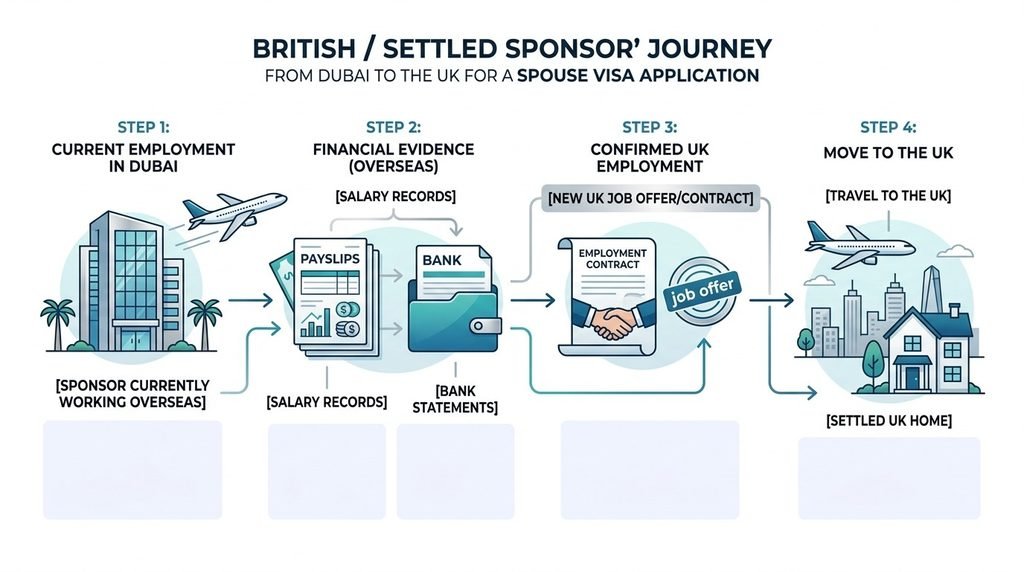
This is one of the most important sections for UAE couples.
A qualifying sponsor can, in specified circumstances, rely on overseas salaried employment while returning to take up employment in the UK. Where the sponsor has been with the current overseas employer for at least six months, the rules contain a calculation based on that overseas employment and the UK employment to which they are returning. The UK job must start within three months of the sponsor’s return.
Where the employment history does not fit that six-month pattern, a different calculation can look at income earned during the 12 months before the application, again alongside the qualifying prospective UK employment.
| Scenario | Evidence Direction | Main Planning Issue |
| Sponsor already working in UK for 6+ months | Relevant payslips, matching bank statements and employer evidence | Make sure the evidence period and salary calculation match |
| British/settled sponsor working in Dubai for 6+ months and returning to UK job | Overseas employment evidence plus qualifying UK job evidence | UK employment must fit the returning-sponsor rule, including the start-date requirement |
| Returning sponsor changed UAE employment recently | 12-month employment-history calculation may become relevant | Do not assume six recent payslips alone solve the requirement |
| Savings used without qualifying income | Potentially £88,500 under the standard £29,000 requirement | Holding period, ownership, accessibility and source evidence matter |
| Self-employed sponsor | Relevant full financial-year evidence or permitted averaging | Evidence categories and combinations are more restrictive |
A small timing decision can therefore have a large effect. For example, resigning from a Dubai role before the application is submitted may alter the category or evidence available. Similarly, where specified evidence relates to a period ending on the application date, the latest item generally cannot be more than 28 days old when the application is made.
If your finances do not fit a standard salary example, having the category and evidence checked before you resign, transfer funds or choose the submission date can be more useful than discovering a mismatch after everything has been uploaded. Bloom Global’s UK visa guidance for UAE residents explains the type of application-preparation support it offers.
What Documents May Be Needed?
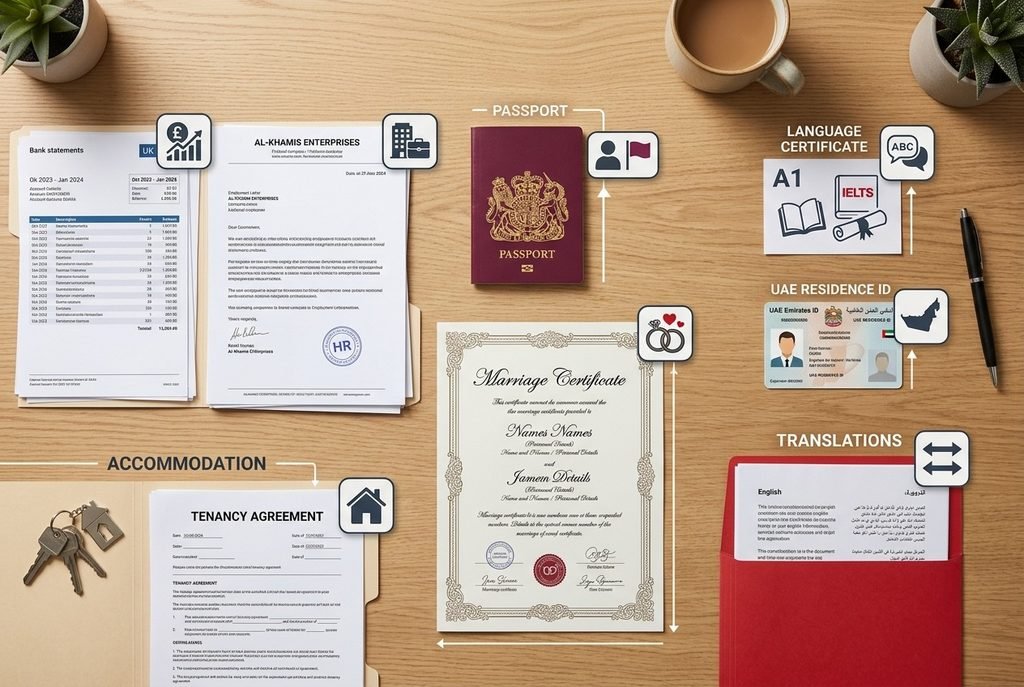
There is no honest universal spouse-visa checklist. The required evidence depends on your relationship, financial category, sponsor status, previous immigration history and other circumstances.
A working document plan may include:
Identity and status
- current passports or travel documents;
- relevant previous passports or immigration history;
- evidence of the UK partner’s British, Irish, settled or other qualifying status;
- evidence of the applicant’s UAE residence/status where relevant.
Relationship
- marriage or civil partnership certificate;
- evidence the relationship is genuine and continuing;
- shared residence or household documents where available;
- relevant joint financial records;
- evidence explaining periods spent living apart where necessary.
Finances and employment
- payslips for the required evidence period;
- corresponding bank statements;
- employer letters;
- a UK employment contract or qualifying employer letter for a returning sponsor;
- self-employment/company documentation where applicable;
- savings statements and source declaration if relying on cash savings.
Accommodation
- suitable evidence of the intended UK accommodation, adapted to the particular housing arrangement.
English
- approved SELT evidence where a test is required, or the appropriate qualification or exemption evidence. The initial family visa test level is normally A1.
Translations
- specified documents not in English or Welsh must be accompanied by a full translation meeting the rules’ verification requirements.
TB evidence, where required
- Dubai residence alone does not automatically mean a TB certificate is required: the UAE is not on the current listed-country page. But someone who recently lived for the relevant period in a listed country can still need testing. UKVI has approved clinics in the UAE for applicants who fall within the requirement.
Before submission, compare the documents against the live GOV.UK partner and spouse family visa guidance and the financial category actually being used.
Step-by-Step: Applying From Dubai
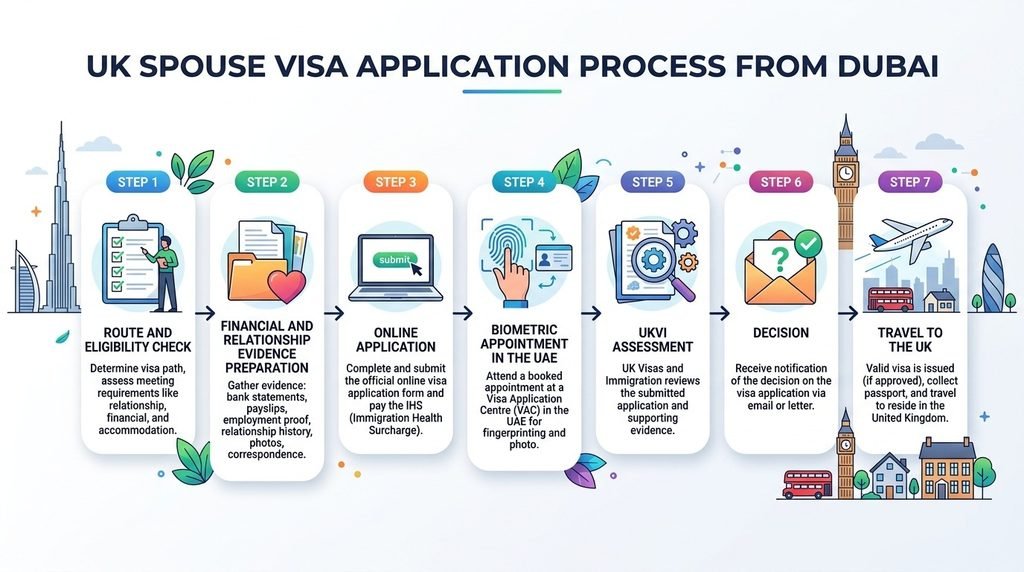
- Confirm the correct immigration route.
Establish whether this is genuinely the family partner route rather than, for example, a dependant route linked to a temporary work visa. - Check the sponsor’s qualifying status and relationship requirement.
Do this before spending time assembling financial documents. - Choose the financial category before choosing the submission date.
If the sponsor is working in Dubai and returning to Britain, map current overseas employment, the proposed UK job and the relevant evidence periods. - Build the document set.
Gather relationship, identity, financial, employment, accommodation, English and any other case-specific evidence. - Check document dates.
Financial evidence can be technically sensitive. Where the specified evidence period ends with the application date, the latest evidence is generally subject to the 28-day rule. - Complete and pay for the online application.
An outside-UK spouse/partner application is submitted online. - Follow the biometric and document-upload instructions.
The system will tell you how to prove identity and where to attend if a visa application centre appointment is required. - Wait for UKVI’s decision before making irreversible travel assumptions.
Current UKVI processing guidance specifically advises applicants not to book travel until a decision has been received.
UKVI/Home Office makes the decision. Neither Bloom Global nor any other adviser or application centre can guarantee approval.
Where Are Biometrics Completed in the UAE?
Where an in-person biometric appointment is required, applicants provide fingerprints and a photograph through the visa application centre process.
Current official UK government listings identify:
- Dubai: UK VFS Visa Application Centre, Wafi Mall, 3rd Floor, Falcon, Phase 2, Umm Hurair 2, Dubai.
- Abu Dhabi: UK VFS Visa Application Centre, Level B2 (Lower Ground), The Mall, World Trade Centre, Khalifa Bin Zayed / 1st Street, Abu Dhabi.
Do not choose a centre or purchase optional services based solely on an article. Apply first and follow the current instructions attached to your application. GOV.UK maintains a live visa application centre finder.
How Much Does a UK Spouse Visa Cost in 2026?
The following government amounts were checked on 22 September 2026. They do not include translation, English testing, document preparation, optional visa-centre services, professional advice or other case-specific expenses.
| Cost | Current Amount | When It Applies | Source / Checked Date |
| Partner/family visa application from outside UK | £2,064 | Main spouse/partner applicant applying outside the UK | GOV.UK, checked 22 Sep 2026 |
| Immigration Health Surcharge — adult, 2 years 9 months | £3,105 | Typical initial partner-family permission of this length | GOV.UK, checked 22 Sep 2026 |
| Dependant child application from outside UK | £2,064 per child | Where an eligible dependant child is included | GOV.UK, checked 22 Sep 2026 |
| IHS — child under 18, 2 years 9 months | £2,328 | Eligible child granted this period | GOV.UK, checked 22 Sep 2026 |
| Priority service | £500 extra | Only where the service is offered and the application is eligible | GOV.UK, checked 22 Sep 2026 |
The IHS is calculated according to the period of immigration permission, so always use the amount generated in the actual application rather than assuming every case will produce the same total.
How Long Does the Process Take?
UKVI currently publishes a 12-week processing time for partner/spouse family visa applications made outside the UK. Processing normally starts after the relevant identity step—for example, attendance at the visa application centre where biometrics are required.
If priority service is available and the case is eligible, the current additional charge is £500 and an outside-UK family application is usually targeted within 30 working days. That service does not guarantee a decision on a particular date.
There is also a second timeline couples often forget: preparation time.
If you need six months of qualifying employment or savings evidence, a fresh English test, translations, or a returning sponsor’s UK job arrangement, the practical preparation period can be considerably longer than the government’s processing period.
That distinction matters when planning a lease termination, school move, UAE employment resignation or international relocation. UKVI itself advises applicants not to book travel until a visa decision has been made.
Can I Bring My Spouse to UK From UAE?
If you’re searching “bring my spouse to UK from UAE”, the practical answer is usually yes—provided the family partner route is the correct route and all applicable requirements are met.
What matters is not merely that you are married. You need to establish the UK partner’s qualifying status, your qualifying relationship, finances, English requirement and the other rules that apply to your circumstances.
Do not confuse a spouse-family visa with a visitor visa. A family visa is designed for living with a qualifying family member in the UK for more than six months. A visit route serves a different purpose.
Bloom Global maintains separate UK Visit Visa guidance for short visits.
Likewise, if the person in Britain is there temporarily on a work or student visa, GOV.UK says a family visa generally is not the appropriate route on that basis; a dependant route may apply instead.
Common Mistakes Applicants From Dubai Should Avoid
Assuming every UAE salary counts.
A British or qualifying settled sponsor’s overseas employment may count under the returning-sponsor provisions, but an overseas applicant’s own employment salary is not simply added as ordinary employment income in an initial entry-clearance case.
Resigning before understanding the financial category.
If current overseas employment is central to the calculation, changing that employment before submission can change what evidence or category is available.
Using the right documents for the wrong period.
Six months, 12 months and full financial years can all appear in the financial rules. They are not interchangeable.
Ignoring evidence recency.
Where the rule requires evidence for a period ending on the application date, the latest specified evidence generally must be dated within 28 days before application.
Treating £88,500 as a universal savings rule.
That figure follows from the current £29,000 requirement when no qualifying income is used. A case using some qualifying income may need a different savings amount, and the permitted combinations still matter.
Sending inconsistent relationship evidence.
Addresses, dates of employment, marriage information and travel history should tell one coherent story rather than contradict one another.
Assuming every Dubai resident has the same TB requirement.
Recent residence in another country can affect whether testing is required. Check the current country rules, not merely your present address.
Using informal translations where specified translation requirements apply.
Documents not in English or Welsh need translations that satisfy the relevant verification requirements.
Treating an official processing target as a guaranteed travel date.
A case can take longer if further checks or information are required. Avoid irreversible travel arrangements before the decision.
UK Spouse Visa From Dubai: Example Scenarios
These examples are deliberately simplified. They illustrate planning questions, not guaranteed outcomes or individual legal advice.
Scenario 1: British spouse employed in Dubai and returning to a UK job
Sara and Adam are married and both live in Dubai. Adam is British and has worked for the same UAE employer for more than six months. He receives a qualifying UK job offer beginning shortly after their planned move.
They should not assume Adam must first live in Britain for six months. Instead, the returning-sponsor provisions may allow qualifying overseas employment to be assessed alongside the new UK employment, provided the detailed income and evidence rules—including the requirement for the UK job to begin within three months of his return—are satisfied.
The key planning question is when to submit relative to Adam’s Dubai employment and UK start date.
Scenario 2: Sponsor already living and employed in the UK
A British sponsor has lived in Manchester for several years while their spouse works in Dubai.
The financial analysis may be more straightforward if the sponsor has qualifying UK salaried employment with a stable history, but the evidence still needs to match the prescribed category. The couple must also document their continuing relationship, particularly if they have spent substantial time living in different countries.
Scenario 3: Couple relying on savings
A couple has substantial accessible savings but the sponsor’s qualifying employment income is below £29,000.
If no qualifying income is being used at all, the current formula produces a savings requirement of £88,500. If some permitted income is available, a lower amount of savings may potentially make up the shortfall. The account ownership, six-month evidence period, source and accessibility of the funds still require attention.
Moving money into a savings account a week before applying does not automatically satisfy those rules.
Scenario 4: Self-employment, a company or unusual history
The sponsor operates a company in the UAE, recently changed ownership structure and intends to continue business activity after moving to Britain. There has also been a previous UK visa refusal.
This is no longer a useful case for a generic “six payslips and six bank statements” checklist. Self-employment has different evidence periods and combination rules, while the previous refusal should be reconciled accurately with the new application.
The first task is to identify the correct legal and financial category, not to collect the largest possible pile of documents.
When Professional Immigration Support May Help
Some couples are comfortable preparing a straightforward application themselves. Others may value professional support where the evidence or immigration route is less obvious.
Examples include a returning British sponsor employed in Dubai, self-employment or company income, mixed income and savings, a previous refusal, significant time living apart, unusual relationship evidence, dependant children, conflicting documents or uncertainty about whether the family route is correct.
Bloom Global describes itself as a Dubai-based provider of UK immigration advisory services. Its website discusses consultation and assessment, document/application preparation, biometric guidance and follow-up support across its UK immigration work.
The role of an adviser is to help you understand and prepare the application. UKVI/Home Office makes the immigration decision.
You can review Bloom Global’s UK immigration advisory overview or contact Bloom Global about your circumstances before deciding whether professional support would be useful.
Frequently Asked Questions
Can I apply for a UK spouse visa while living in Dubai?
Yes. An eligible spouse or partner living in Dubai can apply online from outside the UK. For most entry-clearance categories, the Immigration Rules require the application to be made through a designated post in the country or territory where the person is living.
Your right to reside in the UAE and the location instructions generated during the application should be checked before submission.
Does my spouse need to be living in the UK already?
Not necessarily.
The rules specifically accommodate certain qualifying partners who are employed overseas and are returning to the UK. In a qualifying salaried-employment case, the sponsor’s UK job must begin within three months of their return, with the required evidence of the offer or contract.
That can be particularly relevant for British citizens currently working in Dubai.
What is the UK family visa financial requirement?
For most new partner applications, the current minimum income requirement is £29,000 a year. Exceptions apply in certain benefit cases, while transitional rules apply to some people who first entered the partner route before 11 April 2024.
Meeting the number is only half the task: the funds must come from a permitted source and be evidenced under the relevant rules.
Can UAE income count?
A qualifying sponsor’s overseas employment can count in specified circumstances where that sponsor is returning to employment in the UK.
However, an applicant applying for initial entry clearance from Dubai should not assume their own UAE employment salary can simply be added to the sponsor’s employment income. Appendix FM-SE specifically links the applicant’s employment/self-employment income to situations where the applicant is in the UK and working legally.
Can cash savings be used?
Yes, qualifying cash savings may be used either alone or, where the rules permit, with other qualifying sources.
Under the current standard £29,000 requirement, savings alone require £88,500 using the Immigration Rules formula. Normally the relevant cash needs to have been held for six months, although detailed exceptions apply to certain qualifying assets converted to cash during that period.
How long does a UK spouse visa take from Dubai?
UKVI currently publishes 12 weeks as the standard processing time for an outside-UK partner/spouse family visa.
Where priority service is available and the application is eligible, family applications from outside the UK are usually targeted within 30 working days for an additional £500. These are service targets, not guaranteed decision dates.
Where do I give biometrics in the UAE?
If an in-person biometric appointment is required, current official listings show UK visa application centres in Dubai at Wafi Mall and in Abu Dhabi at The Mall, World Trade Centre.
Apply online first and use the appointment/location instructions generated for your case.
Can I work in the UK on a spouse visa?
A person granted the family visa as a spouse or partner can work in the UK, subject to the conditions of their immigration permission.
Do not confuse this with the fiancé/fiancée family route. GOV.UK expressly states that a fiancé or proposed civil partner cannot work or study during that initial engagement permission; after marriage and a successful partner extension, they gain the right to work or study.
Can my children apply with me?
Eligible children can be added as dependants if they are under 18 when applying, or were under 18 when first granted family leave, and they are not living an independent life. Each dependant has their own application fee and, where applicable, health surcharge.
Children can affect the evidence and overall cost of the move, so include them in planning from the beginning rather than after the main application is ready.
What if my job, savings or other circumstances change before I apply?
Reassess the evidence before submitting.
A change in employer, resignation, new salary, large transfer of savings or altered UK job start date can affect the financial category or evidence period you were intending to use. Because the Home Office assesses the application against the rules and evidence applicable to the case, a checklist prepared several months earlier should not be followed blindly.
Final Thoughts
A UK spouse visa from Dubai is easiest to plan when you stop treating it as one long checklist and instead work through the application in the right order: confirm the route, identify the financial category, select the application date, and then build evidence around the requirements that genuinely apply.
For couples living in the UAE, the returning-sponsor rules are particularly important. The interaction between a Dubai job, a future UK job and the date of application can matter more than the simple headline salary.
Fees, financial rules, processing times and service availability can change. Recheck GOV.UK immediately before submission and remember that UKVI/Home Office—not an adviser—makes the visa decision.
If your finances, employment or relationship evidence are less straightforward, you can speak with Bloom Global about the application before you commit to a submission date.
This article provides general information rather than advice tailored to an individual’s immigration circumstances.