

Many international professionals begin their UK career journey with excitement, planning their move around a job offer, a new lifestyle, and long-term career opportunities. However, immigration rules do not remain static. A role that qualified under previous rules may require a different assessment under the updated system.
The Skilled Worker visa 2026 landscape has introduced important changes affecting salary requirements, eligible job levels, English language standards, and employer sponsorship responsibilities. These changes are particularly important for overseas professionals, UK employers holding sponsor licences, and businesses planning international recruitment.
The Skilled Worker visa 2026 changes have made the route more focused on higher-skilled professional roles, with stricter salary expectations, higher English language requirements, and increased scrutiny of sponsored employment.
For applicants, the key questions are now:
- Does my job qualify under the updated skill level rules?
- Does my salary meet the required threshold?
- Does my employer have a valid UK sponsor licence?
- Do I meet the updated English language requirement?
- Are my documents prepared correctly before applying?
For employers, the challenge is ensuring that recruitment decisions, job descriptions, salaries, and sponsorship compliance remain aligned with Home Office expectations.
At Bloom Global, we help professionals and businesses understand changing UK immigration requirements and prepare applications with a clear understanding of the rules, risks, and documentation requirements.
Skilled Worker visa 2026: What Has Changed?
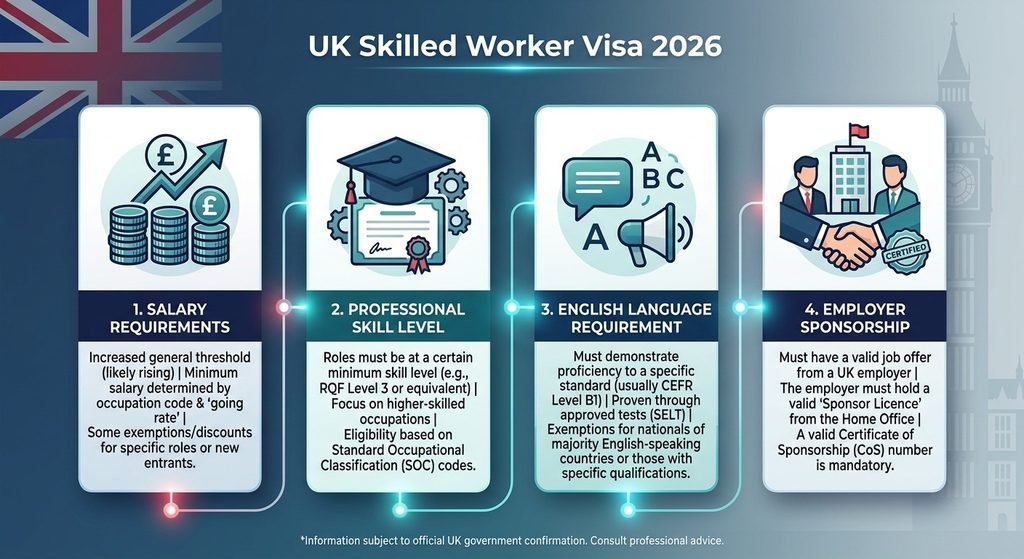
The main Skilled Worker visa changes in 2026 relate to salary thresholds, job skill levels, and English language requirements. The route has moved towards attracting higher-skilled professionals while increasing compliance expectations for sponsoring employers.
The UK Skilled Worker route operates through a relationship between:
UK Skilled Worker visa → Home Office → Licensed sponsor → Certificate of Sponsorship (CoS) → Eligible occupation → Visa application
A successful application requires all parts of this chain to work together.
A strong job offer alone is not enough. The role must meet immigration requirements, the employer must follow sponsor duties, and the applicant must satisfy personal eligibility conditions.
Key Skilled Worker visa 2026 updates at a glance
| Requirement | 2026 Position | Impact |
| Salary | Higher minimum salary thresholds apply for many applicants | Applicants may need higher-paying roles |
| Job skill level | Greater focus on graduate-level occupations | Some lower-skilled roles may no longer qualify |
| English language | B2 CEFR requirement for relevant new applicants | Applicants need stronger English ability |
| Sponsorship | Employer compliance remains critical | Sponsors must maintain accurate records |
| Documentation | Greater importance placed on genuine employment evidence | Poor preparation can increase refusal risks |
Why the 2026 UK Skilled Worker visa Updates Matter
The 2026 changes matter because both applicants and employers must reassess whether a role genuinely meets current immigration requirements before relying on sponsorship.
Previously, some applicants focused mainly on finding a sponsor. In 2026, the process requires a deeper review:
- The occupation code must match the actual duties.
- The salary must satisfy the correct threshold.
- The role must meet the required skill level.
- The applicant must demonstrate the required English ability.
- The employer must maintain sponsor compliance.
For example:
A marketing professional offered a job titled “Marketing Manager” may assume they qualify automatically. However, the Home Office will look beyond the job title and consider:
- Actual responsibilities
- Salary level
- SOC occupation code
- Required skills
- Employer evidence
This means employers should avoid creating roles purely around visa eligibility. The sponsored position must represent a genuine business need.
UK skilled worker visa salary 2026: New Requirements Explained

The UK skilled worker visa salary 2026 requirement generally requires applicants to meet the applicable minimum salary threshold or the occupation-specific going rate, whichever is higher.
Salary is one of the most important parts of a Skilled Worker visa application because it determines whether the sponsored role meets Home Office requirements.
For many applications, the standard salary threshold is £41,700 per year, although different rules can apply depending on factors such as:
- Previous immigration status
- Whether the applicant qualifies as a new entrant
- Relevant PhD qualifications
- Specific occupation rules
- National pay scales
How salary requirements work
The Home Office does not simply look at the salary written on the employment contract.
It considers:
- The general Skilled Worker salary threshold
- The going rate for the occupation code
- Whether the applicant qualifies for a salary discount category
The applicant normally needs to satisfy whichever figure is higher.
Example
A company offers:
- Job: Software Developer
- Salary: £45,000 per year
If the occupation going rate is higher than £45,000, the salary may still not meet the requirement.
The employer must check the occupation-specific rate before assigning the Certificate of Sponsorship.
Salary categories under Skilled Worker visa rules
| Applicant Category | Possible Salary Treatment |
| Standard Skilled Worker applicant | Usually must meet the full salary threshold and going rate |
| New entrant | May qualify for reduced salary requirements if eligibility conditions are met |
| Relevant PhD holder | May qualify for salary reductions |
| Certain shortage occupations | Special salary rules may apply |
What does the salary change mean for applicants?
Applicants now need to focus on the quality and level of the role, not simply finding any sponsored job.
Common impacts include:
1. Entry-level roles may become harder
Some lower-paid positions may no longer satisfy salary requirements unless specific exceptions apply.
2. Career planning becomes more important
Professionals may need to consider:
- Professional qualifications
- Industry experience
- Higher-skilled roles
- Employers offering competitive salaries
3. Job title alone is not enough
A senior title with limited responsibilities may create problems during assessment.
The Home Office may examine whether:
- Duties match the occupation code
- The role is genuine
- Salary reflects the market level
What employers should know about Skilled Worker visa salary rules
UK employers sponsoring overseas workers must ensure salary decisions are commercially genuine and compliant with Home Office sponsorship rules.
Before assigning a Certificate of Sponsorship, employers should review:
Recruitment checklist
✓ Correct SOC occupation code selected
✓ Job description accurately reflects duties
✓ Salary meets immigration requirements
✓ Employment contract matches sponsorship details
✓ Payroll records support the salary paid
✓ Sponsor licence records are maintained
A sponsor licence is a responsibility, not simply permission to hire overseas workers.
Employers must continue meeting sponsor duties after the visa is granted.
UK skilled worker visa RQF level 6 Requirement Explained

The UK skilled worker visa RQF level 6 requirement reflects the move towards sponsoring roles considered equivalent to graduate-level occupations, although some exceptions and transitional arrangements may apply.
The Regulated Qualifications Framework (RQF) is used to measure the skill level of occupations in the UK.
RQF Level 6 is broadly associated with roles requiring:
- Graduate-level knowledge
- Professional expertise
- Advanced decision-making responsibilities
Examples may include roles in:
- Information technology
- Engineering
- Finance
- Professional services
- Management
- Healthcare
- Scientific fields
Why RQF Level 6 matters
A common misunderstanding is:
“My job title sounds professional, so I qualify.”
This is not always correct.
The Home Office considers:
- The occupation code
- Actual job duties
- Required knowledge
- Responsibilities involved
For example:
A “Business Manager” role involving strategic planning, financial management, operational leadership, and decision-making may be assessed differently from a basic administrative position using a similar title.
Applicants should review these areas before applying
| Question | Why It Matters |
| Is my occupation eligible? | Not every job qualifies |
| Does my SOC code match my duties? | Incorrect coding can cause refusal |
| Does my experience support the role? | The job must be credible |
| Is my salary appropriate? | Salary and skill level are connected |
UK visa English requirement B2 2026: What Applicants Need to Know
The UK visa English requirement B2 2026 update means many new Skilled Worker visa applicants must demonstrate a higher level of English language ability compared with previous requirements. The required standard is measured using the Common European Framework of Reference for Languages (CEFR). (GOV.UK)
English ability is a key part of the UK immigration system because sponsored workers are expected to communicate effectively in professional environments.
For applicants, this means English preparation should not be treated as a final administrative step. It should be considered early in the visa planning process.
What does B2 English level mean?
B2 CEFR represents an upper-intermediate level of English where a person can communicate confidently in workplace and everyday situations.
A person at B2 level should generally be able to:
- Understand complex workplace discussions
- Communicate clearly with colleagues and customers
- Write professional emails and documents
- Explain ideas and opinions effectively
- Participate in meetings and professional conversations
The requirement is designed to ensure sponsored workers can function effectively in UK workplaces.
Who needs to prove English language ability?
Applicants usually need to prove their English ability unless they qualify for an exemption.
Evidence may include:
| Method | Description |
| Approved English language test | A Home Office-approved Secure English Language Test (SELT) |
| Academic qualification | Certain degrees taught in English may be accepted |
| Previous UK immigration history | Some applicants may already meet the requirement |
| Nationality exemption | Citizens of certain English-speaking countries may not need evidence |
Applicants should always check the latest Home Office guidance before submitting an application because requirements can vary depending on personal circumstances.
How Employers Can Prepare for Skilled Worker Visa Sponsorship in 2026

Employers sponsoring overseas workers in 2026 must focus on genuine recruitment, accurate job descriptions, correct salary levels, and ongoing sponsor licence compliance.
The Skilled Worker visa system is built around the relationship between:
Employer → Sponsor Licence → Certificate of Sponsorship → Skilled Worker visa application
A mistake at any stage can affect the entire application.
Sponsor licence responsibilities
A UK employer with a sponsor licence must maintain systems to demonstrate compliance.
Key responsibilities include:
1. Record keeping
Sponsors should maintain:
- Employment contracts
- Right-to-work checks
- Salary records
- Attendance information
- Contact details
- Recruitment evidence
2. Reporting duties
Sponsors must report relevant changes, including:
- Employee not starting sponsored employment
- Significant changes to job duties
- Changes in employment circumstances
- Certain organisational changes
3. Genuine vacancy requirement
The role must represent a real business need.
Employers should avoid:
- Artificial job descriptions
- Inflated job titles
- Roles created only to support visa applications
The Home Office may assess whether the sponsored position reflects genuine business activity.
How Businesses Can Improve Skilled Worker Visa Compliance
The strongest sponsors treat immigration compliance as part of normal HR operations rather than a separate process.
A practical compliance framework includes:
| Area | Recommended Practice |
| Recruitment | Keep evidence of how candidates were selected |
| Job descriptions | Ensure duties match SOC occupation codes |
| Payroll | Pay the sponsored salary correctly and consistently |
| HR records | Maintain updated employee files |
| Visa monitoring | Track expiry dates and immigration status |
For growing businesses, implementing structured HR systems can significantly reduce compliance risks.
Common Mistakes Skilled Worker Visa Applicants Should Avoid
Many Skilled Worker visa refusals happen because applicants focus only on receiving a job offer and overlook technical immigration requirements.
Below are common mistakes to avoid.
1. Choosing the wrong occupation code
A job title does not automatically determine eligibility.
For example:
A company may advertise a role as “Operations Manager”, but the actual duties may be closer to administrative support.
The Home Office looks at the duties performed, not only the title.
2. Accepting a salary without checking immigration rules
Applicants sometimes assume:
“My salary is above minimum wage, so my visa should be fine.”
This is incorrect.
The relevant questions are:
- Does the salary meet the Skilled Worker threshold?
- Does it meet the occupation going rate?
- Does the applicant qualify for any discount?
3. Ignoring English requirements
Waiting until the final stage to arrange English evidence can delay applications.
Applicants should confirm:
- Whether they need a test
- Which tests are accepted
- Whether existing qualifications are sufficient
4. Submitting inconsistent documents
Immigration applications require consistency.
Common issues include:
- Different job titles across documents
- Salary mismatch
- Incorrect employment dates
- Missing evidence
A careful document review before submission can prevent avoidable problems.
Step-by-Step Skilled Worker Visa Application Process 2026
The Skilled Worker visa application process involves securing an eligible sponsored job, receiving a Certificate of Sponsorship, preparing evidence, and submitting an application to the Home Office.
Step 1: Find an eligible sponsored job
The applicant must find employment with a UK employer that:
- Holds a valid sponsor licence
- Offers an eligible occupation
- Meets salary requirements
Step 2: Confirm sponsorship eligibility
Before accepting the offer, review:
- SOC occupation code
- Salary
- Job duties
- Employer sponsor status
A proper assessment at this stage reduces future problems.
Step 3: Receive Certificate of Sponsorship (CoS)
The employer assigns a digital Certificate of Sponsorship.
The CoS contains important information, including:
- Employer details
- Job information
- Salary
- Start date
- Occupation code
The applicant cannot apply without valid sponsorship details.
Step 4: Prepare supporting documents
Typical documents may include:
- Valid passport
- Certificate of Sponsorship reference number
- Proof of English language ability
- Salary evidence
- Qualification documents (where relevant)
- Financial evidence if required
- Previous immigration documents
Step 5: Submit the visa application
The applicant completes the online application, pays the required fees, attends biometrics if required, and waits for the Home Office decision.
Skilled Worker Visa 2026: Applicant Checklist
| Requirement | Completed? |
| Eligible sponsored job found | ☐ |
| Employer has valid sponsor licence | ☐ |
| Correct occupation code confirmed | ☐ |
| Salary requirements checked | ☐ |
| English requirement satisfied | ☐ |
| Documents reviewed | ☐ |
| Application submitted correctly | ☐ |
Skilled Worker visa 2026 Frequently Asked Questions
What is the Skilled Worker visa?
The Skilled Worker visa is a UK immigration route that allows eligible overseas professionals to work for approved UK employers with a valid sponsor licence.
Applicants must usually have:
- An eligible job
- A licensed sponsor
- Required salary level
- Required English ability
What salary is required for a UK Skilled Worker visa in 2026?
The required salary depends on the applicant’s circumstances, occupation code, and applicable immigration rules.
Many applicants must meet both:
- The general Skilled Worker salary threshold
- The occupation-specific going rate
Applicants should check the latest Home Office guidance before applying.
Has the English requirement changed for UK Skilled Worker visa applicants?
Yes, English language requirements have increased for many new applicants, with the required level moving to B2 CEFR for relevant applications from 2026.
Can employers still sponsor overseas workers in 2026?
Yes. UK employers can continue sponsoring overseas workers if they hold a valid sponsor licence and comply with Home Office requirements.
What is RQF Level 6 for Skilled Worker visa applications?
RQF Level 6 refers to occupations requiring graduate-level skills and professional knowledge. Many eligible Skilled Worker occupations are assessed against this framework.
Does a job title decide Skilled Worker visa eligibility?
No. The Home Office considers the actual duties, occupation code, salary, and employment circumstances rather than the job title alone.
Can a Skilled Worker visa application be refused after receiving a Certificate of Sponsorship?
Yes. A CoS allows an applicant to apply but does not guarantee approval.
Applications can fail if:
- Salary requirements are not met
- Documents are inconsistent
- English requirements are not satisfied
- The role does not match eligibility requirements
How long does a Skilled Worker visa last?
A Skilled Worker visa can usually be granted for up to five years, depending on the employment period and application circumstances.
Can Skilled Worker visa holders apply for settlement?
Many Skilled Worker visa holders may become eligible for settlement after meeting the relevant continuous residence, eligibility, and immigration requirements.
How Bloom Global Can Help With Skilled Worker Visa Applications
Navigating UK immigration changes can be challenging, especially when salary rules, occupation requirements, and sponsorship compliance continue to evolve.
Bloom Global supports individuals and businesses by helping them understand:
- Skilled Worker visa eligibility
- Sponsorship requirements
- Document preparation
- Employer compliance considerations
- Application strategy
If you are unsure how the Skilled Worker visa 2026 changes affect your situation, professional guidance can help you understand your options before submitting an application.