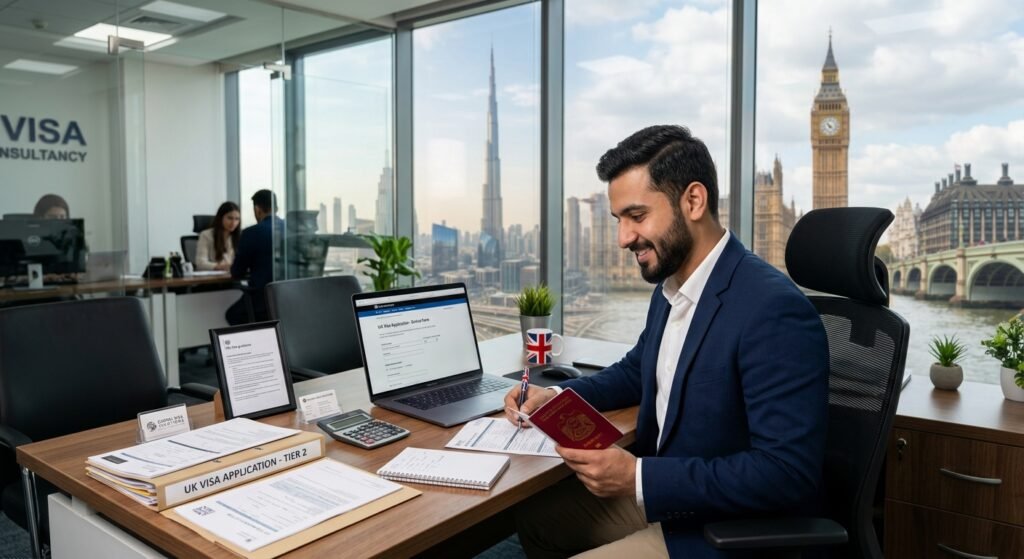

The Innovator Founder route allows eligible entrepreneurs to establish and actively develop an innovative, viable and scalable business in the United Kingdom. It is intended for genuine founders, not passive investors, and requires endorsement before the visa application. For Dubai, UAE and GCC entrepreneurs, the key issue is not whether a concept has worked at home, but whether it can become a credible and differentiated UK venture.
It is nearly midnight in Dubai. A founder is reviewing a pitch deck that impressed UAE customers. One question remains: will Britain see genuine innovation, or a successful Gulf business copied into a new market?
UAE traction can support credibility, but endorsement is not a reward for past success. The UK case needs its own evidence of market need, competitive difference, deliverability and growth.
Quick Answer: What Is the Innovator Founder Route?
The Innovator Founder route is a UK business immigration pathway for founders establishing and running a new business based on an innovative, viable and scalable proposition. The founder needs endorsement from an authorised organisation, must meet the personal immigration requirements and must remain actively involved. The endorsing body assesses the business case; UK Visas and Immigration decides the visa application.
Founders can review Bloom Global’s Innovator Founder support page. Bloom Global also publishes a detailed UK Innovator Founder Visa guide covering the broader rules.
The official GOV.UK overview states that the route normally grants permission for up to three years. Under the current Immigration Rules Appendix Innovator Founder, applicants must be at least 18, hold a qualifying endorsement issued no more than three months before applying, meet English at B2 level unless exempt, and satisfy the financial and suitability requirements. The founder must also have generated or significantly contributed to the idea and hold a key day-to-day role.
Key Takeaways for Dubai and GCC Founders
- UAE traction can strengthen a case but does not automatically prove UK-route innovation.
- UK research should test customers, competitors, pricing, regulation, costs and routes to market.
- The founder’s personal contribution must be clear; passive investment is insufficient.
- Endorsement and the visa application are connected but separate decisions.
- There is no universal initial investment minimum, but the plan must be credibly funded.
- Forecasts should be evidence-led, consistent and achievable.
- Budget for endorsement, visa, healthcare surcharge, contact-point and dependant costs.
Is the Innovator Founder Visa Right for Your Business?
It may suit a founder with a differentiated UK proposition, relevant capability, sufficient resources and an operational role. It may be unsuitable where the main plan is passive investment, joining an existing trading business, opening a conventional local company with minor technology added, or relocating before the business case is ready.
Who may be a strong fit?
Potentially stronger profiles can explain:
- the UK problem and target customer;
- why existing alternatives are inadequate;
- what the founder or team created or materially shaped;
- why the proposition is difficult to replicate;
- what resources are available for launch; and
- how the model can grow beyond a small local operation.
Founding teams are permitted, but each applicant needs an individual endorsement and must meet the route requirements independently.
Who may need another route or more preparation?
An idea may need refinement when its “innovation” is mostly branding, a generic app, third-party technology or a familiar service delivered conventionally. Warning signs also include unsupported forecasts, weak UK demand evidence, or a founder who cannot explain the technical or commercial model.
Some professionals may be better aligned with a talent-led pathway. Bloom Global’s Global Talent service page offers a comparison. Suitability depends on current rules and individual evidence.
What Do “Innovative, Viable and Scalable” Actually Mean?
The tests work together. Innovation asks what is different. Viability asks whether the founder and resources can deliver it. Scalability asks whether there is a researched path to wider growth, skilled employment and national or international markets.
Innovative
Innovation is not simply using software, artificial intelligence or an app. Official guidance focuses on a compelling difference, barriers to replication and innovation that is central to the business rather than incidental or almost entirely outsourced.
For a Dubai founder, ask: what changes in the UK, and why will British customers choose this over established alternatives? A conventional service with a booking app may remain conventional. A proprietary system, distinctive process, defensible data advantage or new commercial model may present a stronger case if the claims are demonstrable.
Viable
Viability means the plan is realistic with the available resources. Relevant experience matters, as do credible costs, funding, market awareness, operational capability and evidence that customers may pay the proposed price.
A practical implementation plan can carry more credibility than a dramatic forecast. The founder should explain hires, milestones, regulation, customer acquisition and cash runway.
Scalable
Scalability requires more than the possibility of opening a second location. The plan should show what can expand, how capacity increases, where skilled jobs arise and why demand extends into wider markets.
| Assessment Area | What It Generally Means | Evidence a Founder Might Prepare | Common Weakness |
| Innovation | A genuine, central competitive difference | Prototype, process map, competitor comparison, IP strategy, test results | Calling an ordinary business innovative because it uses an app or AI |
| Viability | A deliverable plan supported by skills, funds and demand | Founder CV, team roles, supplier quotes, pricing tests, cash-flow model | Generic costs, unexplained funding or dependence on outsourced capability |
| Scalability | A researched route to wider growth and skilled jobs | Milestones, capacity model, hiring plan, channels, export strategy | Ambitious revenue without operational steps or evidence |
| Founder contribution | Material creation and active execution | Development history, decisions, technical or commercial work, ownership records | Joining late mainly as an investor |
These are preparation prompts, not guaranteed criteria. The authorised endorsing body assesses the venture and founder.
Can a Successful Dubai Business Qualify?
Potentially, but Dubai success is evidence—not a substitute for the UK assessment. UAE traction may support founder credibility, unit economics and proof that a problem exists. The UK venture must still meet current new-business, differentiation and scalability requirements.
Separate “what worked in the UAE” from “what has been validated for Britain”. Customer behaviour, procurement, employment costs, data rules, tax, regulation, logistics and competition may differ. Simply converting dirhams to pounds will not resolve those differences.
Useful translation of UAE traction can include:
- mapping UAE customers to comparable UK segments;
- conducting UK interviews, pilots or channel discussions;
- testing UK pricing;
- identifying UK competitors and a specific advantage;
- adapting operations to UK regulation and costs; and
- defining which capabilities belong to the founder and which require UK hires.
Commercial success and route-specific innovation are different tests. A profitable conventional business may remain unsuitable, while an earlier-stage venture may be stronger when its innovation, execution capability and UK opportunity are evidenced.
How Does the Endorsement Process Work?
An authorised endorsing body assesses the founder and business proposition; it does not grant the visa. After endorsement, the founder applies separately to UK Visas and Immigration, which checks identity, suitability, funds, English, documents and endorsement validity. The stages are connected, but one positive decision does not guarantee the other.
As of 14 July 2026, the official GOV.UK list of authorised endorsing bodies names UK Endorsing Services, Innovator International and Envestors Limited as business endorsing bodies for new applications. The Global Entrepreneurs Programme can endorse founders already invited to its programme. Legacy bodies generally cannot accept new initial cases.
What might an endorsing body examine?
The assessment may cover originality, founder contribution, resources, market need, defensibility, delivery, forecasts, skills, growth potential and source-of-funds due diligence. Each organisation has its own process, so use the live official list and current instructions.
What happens after endorsement?
The letter must be current when the visa application is filed. If permission is granted, contact-point meetings normally take place around months 12 and 24. Progress may be tested through milestones such as product development, sales, jobs, intellectual property or investment. Official guidance also provides for a site visit at a checkpoint.
Why can endorsements be withdrawn?
Withdrawal may occur if the founder fails to stay in contact, does not develop the business, misses monitoring without authorisation, or pursues a failed or replacement venture that is not considered innovative, viable and scalable. Pre-decision withdrawal leads to refusal; later withdrawal can prompt the Home Office to consider shortening permission. The Home Office makes the immigration decision.
What Documents and Evidence May Be Needed?
The evidence package normally combines personal immigration documents with a coherent founder-and-business case. What is required depends on the applicant, the endorsing body and the rules in force, but every figure and claim should remain consistent across the endorsement submission, visa form, pitch deck and financial model. A preparation file may include:
- Identity and immigration: passport, history, biometric steps and certified translations.
- English: an approved test, qualifying degree or another accepted B2 method, unless exempt.
- Maintenance: currently £1,270 for many overseas applicants, held for 28 days, plus applicable dependant funds.
- Endorsement: a qualifying letter issued no more than three months before applying.
- Business plan: problem, solution, market, model, operations, milestones, risks and growth.
- UK market evidence: customer research, competitors, pricing, regulation, distribution and demand.
- Financials: start-up costs, funding sources, cash flow, hiring and downside scenarios.
- Founder evidence: CV, expertise and proof of material contribution.
- Product, IP and traction: prototypes, ownership, tests, contracts, pilots, invoices or letters of intent.
The plan, application, deck and model should tell the same story. Conflicting dates, ownership, revenue, staffing or funding create avoidable credibility questions.
A Dubai-to-UK Preparation Roadmap
- Test the idea. Define the problem, user and substantive innovation.
- Research the UK market. Validate demand, competition, pricing, regulation and costs.
- Define the founder’s contribution. Record what you created, tested and will lead.
- Develop the business model. Explain revenue, delivery and defensibility.
- Build realistic financials. Tie numbers to evidence, quotations or stated assumptions.
- Prepare the endorsement case. Align the plan, pitch, evidence and founder narrative.
- Prepare the visa application. Check the letter, personal documents, English and funds.
- Plan the UK launch. Address operations, banking, premises, hiring, suppliers and family logistics.
- Track progress. Keep evidence against milestones for checkpoints, extensions or settlement.
Before spending heavily, test whether UK demand is independently supported, whether the innovation can be explained without buzzwords, whether the founder can deliver it and whether the plan survives a conservative cash-flow scenario. A “not yet” assessment can prevent a premature application.
Common Innovator Founder Mistakes
- Treating a standard business as innovative because technology is mentioned.
- Reusing UAE research without UK evidence.
- Inflating market size, customers, jobs or revenue.
- Failing to explain the founder’s role.
- Confusing investment with innovation.
- Approaching an unauthorised organisation.
- Relying on outdated requirements.
- Assuming endorsement guarantees the visa.
- Using inconsistent figures across documents.
- Making unsupported customer, IP or partnership claims.
Credibility comes from traceable evidence and sensible assumptions. A modest first-year forecast with clear growth conditions may be stronger than an unsupported hockey-stick projection.
How Long Can the Process Take?
There is no single official end-to-end timeline because business preparation and endorsement assessment vary. As checked on 14 July 2026, GOV.UK says visa applicants usually receive a decision within three weeks outside the UK and eight weeks inside the UK, after proving identity and providing documents.
Plan separate blocks for business validation, endorsement preparation, visa processing, possible evidence requests and post-approval relocation. Endorsement timing depends on readiness, the chosen authorised body, interviews and further-information requests.
From 8 April 2026, the application fee is £1,357 per person outside the UK or £1,693 for an in-country extension or switch. Endorsement costs £1,000, and each mandatory contact-point meeting costs £500, excluding VAT where applicable. The healthcare surcharge is additional.
Can the Route Lead to UK Settlement?
Yes, settlement may be possible after three years, but it is not automatic. A founder needs a fresh endorsement, qualifying continuous residence, the Life in the UK requirement where applicable, an active and sustainable business, a continuing key role and evidence that the venture meets at least two specified business-performance criteria.
Current criteria include options relating to investment spent, customer growth, research and UK IP protection, revenue, exports and job creation. The same criterion cannot be counted twice, and team members cannot necessarily share the same achievement. Absences are generally limited to 180 days in any 12-month period.
Maintain reliable accounts, Companies House records, payroll, customer data, contracts and development evidence from the start.
How Bloom Global Supports UAE and GCC Founders
Bloom Global presents itself as a Dubai-based UK immigration consultancy serving founders and other applicants across the UAE and GCC. Its published service includes eligibility assessment, endorsement guidance, business-plan creation or refinement, online application support, interview preparation, biometric guidance and UK arrival planning.
An adviser can help structure the process, identify evidence gaps and test consistency. Bloom Global does not issue endorsements or decide visas; those decisions belong to authorised endorsing organisations and UK authorities.
Not sure whether your concept is ready? Use the Bloom Global contact page to request an eligibility assessment or consultation.
Questions to Ask Before Booking a Consultation
- What is genuinely new or defensible in the UK proposition?
- Which UK customers have been tested, and how?
- What supports pricing and demand?
- What did I personally create or materially contribute?
- Which delivery elements depend on third parties?
- How much funding is available and what milestones will it cover?
- Are the plan, deck, model and application consistent?
- What are the largest endorsement gaps today?
- Which authorised body may be relevant, and why?
- What should be true before I spend more?
Frequently Asked Questions
Is the Innovator Founder Visa the same as the old Innovator Visa?
It is the successor to the Innovator route, but applicants must use the current rules. The newer route removed the former universal £50,000 initial investment requirement and permits qualifying skilled employment outside the founder’s business. Old articles may therefore be materially misleading, particularly on funding and work conditions.
Is there a fixed minimum investment amount?
No universal minimum is stated for every initial application. However, “no fixed minimum” does not mean “no funding needed”. The founder must show that the plan is realistic with available resources, while the endorsing body may examine costs, funding sources and whether forecasts can be defended.
Can I use an existing UAE business idea?
Potentially, but the proposed UK venture must satisfy the current new-business, innovation, viability, scalability and founder-role requirements. UAE evidence can support demand and capability, yet a direct copy is not automatically suitable. The facts and proposed structure should be assessed before money is committed to the full process.
Do I need an approved endorsing body?
Yes. A new application needs endorsement from an organisation authorised for the route. Use the live GOV.UK list rather than an old directory or unsupported provider claim. An unauthorised organisation cannot issue a valid new endorsement, even if it describes its service as endorsement support or business assessment.
Can my family join me?
Eligible partners and dependent children can apply, subject to current relationship, age, financial and suitability rules. Each dependant applies and normally pays the visa fee and healthcare surcharge. Check maintenance evidence immediately before filing because the required amount depends on family composition and immigration history.
Can I work outside my business?
Yes, current rules permit outside employment when the role requires at least RQF Level 3 skills. Restrictions still apply, including professional sport. Outside work should not undermine the founder’s active day-to-day role in the endorsed venture or conflict with the conditions stated in the permission.
How long is the visa normally granted for?
Permission is normally granted for up to three years. Further three-year extensions may be available with a new endorsement and compliance with the rules then in force. There is no stated limit on the number of extensions, although every later application is assessed under the rules then in force.
Does endorsement guarantee visa approval?
No. Endorsement supports the business case. UK Visas and Immigration separately assesses validity, identity, English, funds, suitability and the other immigration requirements. Either stage can raise questions or further evidence requests in an individual case, and neither Bloom Global nor an endorsing body can guarantee approval.
Final Thoughts: Turning a Dubai Idea into a UK Business
The Innovator Founder journey is not won by the longest plan or boldest forecast. The real question is whether the founder can show a genuine UK opportunity, a meaningful difference, the resources to deliver and a credible path to growth.
For Dubai and GCC entrepreneurs, UAE traction becomes valuable when translated carefully into UK evidence. Validate the market, explain your contribution, use conservative assumptions and treat endorsement as the beginning of an accountable business journey.
When the hypothetical founder closes the laptop, the next step should not be another optimistic graph. It should be testing the weakest assumption. That is how a promising UAE concept becomes a stronger UK launch plan.
Ready to assess your concept? Speak with Bloom Global about an eligibility assessment and preparation roadmap before committing to the full process.
Disclaimer: This article provides general information and does not constitute legal advice. UK immigration rules, fees, processing times, and endorsing-body arrangements can change. Check the latest GOV.UK guidance and obtain advice based on your circumstances before applying.
This page should be reviewed whenever official immigration requirements or endorsing-body arrangements change.