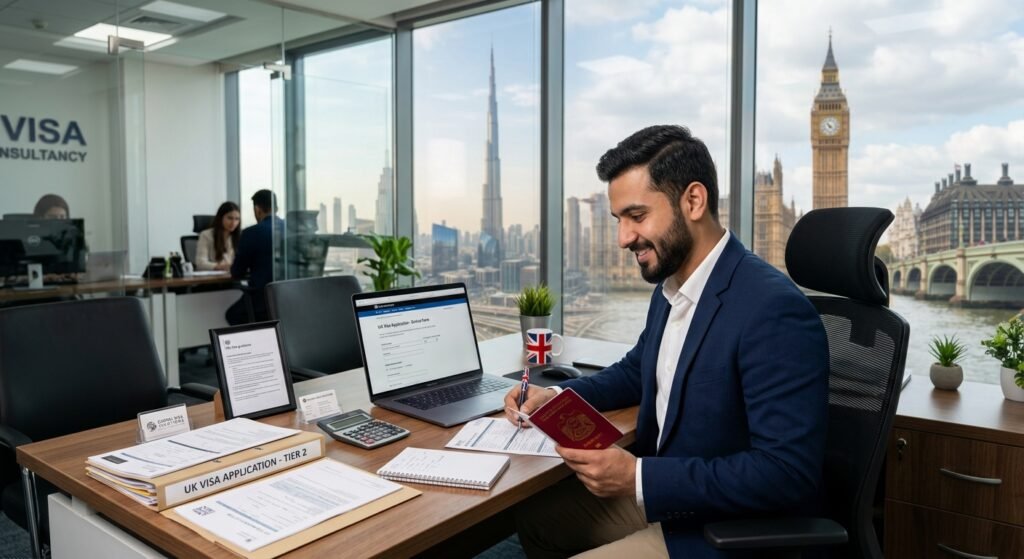

You’re living in Dubai. Your spouse is British, Irish or settled in the UK—or perhaps you’re both in the UAE and planning a move back together. You have passports, a marriage certificate and months or years of shared history. Then the practical questions begin.
Which income actually counts? How much evidence is enough? Does living in Dubai change the application? And how early should you start preparing documents that have strict timing requirements?
For a UK spouse visa from Dubai, the official route is normally the UK family visa as a partner or spouse. Applicants generally need to satisfy relationship, sponsor-status, financial, English-language and accommodation requirements, submit an online application from outside the UK, and complete the required identity and biometric process. UK Visas and Immigration (UKVI), part of the Home Office, makes the decision—not an immigration consultancy.
The rules below were checked against current GOV.UK and Home Office information on 5 September 2026. Immigration requirements and fees can change, so always recheck official guidance close to the date you apply.
UK Spouse Visa from Dubai: The Quick Answer
Yes, someone living in Dubai can apply for a UK family visa as a spouse or partner if they meet the relevant requirements. You do not need to be a UAE citizen simply because you are applying from Dubai; for this type of entry-clearance application, the application should normally be made in the country where you are living.
For a typical first partner application in 2026, check that:
- both partners are at least 18;
- the UK-based or returning partner has a qualifying immigration status;
- the relationship meets the relevant spouse, civil partner or partner requirements;
- the couple intends to live together permanently in the UK;
- the applicable financial requirement is met;
- the applicant meets the English-language requirement or qualifies for an exemption;
- suitable accommodation will be available in the UK;
- the evidence matches the rules that apply to the couple’s particular circumstances; and
- the application is submitted from outside the UK with the required identity and biometric steps completed.
A good starting point is the official GOV.UK family visa guidance for partners and spouses.
Who Can Apply for a UK Spouse Visa from Dubai?
The short answer is that the applicant and partner must meet both relationship and immigration-status requirements. Being married is important, but a marriage certificate by itself does not establish every requirement of the route.
Relationship Requirements
For the family visa partner route, both people must be 18 or over. GOV.UK says applicants must generally show one of several qualifying relationships, including a marriage or civil partnership recognised in the UK, qualifying cohabitation, or a relationship of at least two years where living together has not been possible for reasons such as work, study or cultural circumstances. The relationship must also be genuine and continuing, and the couple must intend to live together permanently in the UK.
For married couples, think beyond the certificate.
UKVI may consider how the relationship fits together as a whole: how you met, periods you lived together or apart, shared financial responsibilities and evidence of ongoing contact where you have lived separately. GOV.UK specifically identifies documents such as marriage certificates, tenancy agreements, joint financial records and other evidence connecting the couple.
This is where evidence quality matters. Ten screenshots from the same week may say less about a long-term relationship than a smaller, well-organised set of evidence covering the relevant timeline.
Sponsor and Immigration Status
The partner being joined must have a qualifying status. Current GOV.UK guidance includes, among others, British or Irish citizens, people settled in the UK, certain people with pre-settled status, and people with specified protection or stateless-person status.
There is a specific 2026 point for some protection-status cases. Where the sponsoring partner has protection status and claimed asylum after 2 March 2026, the length of the partner’s permission may in some circumstances end when the sponsor’s permission ends rather than running for the usual full period.
That provision will not affect the typical case involving a British citizen or someone permanently settled in the UK, but it illustrates why applicants should check the current rules rather than relying on an old spouse-visa checklist.
Applying While Living in Dubai
Dubai is the applicant’s location; it is not the authority deciding the UK visa.
For entry clearance routes other than specified exceptions, Home Office policy says applications should generally be made in the country where the person is living. GOV.UK also lists the United Arab Emirates among countries with UK visa application-centre arrangements.
A British Embassy Dubai page currently identifies a UK VFS Visa Application Centre at Wafi Mall in Dubai. Applicants should still use the appointment information given during the current application process rather than relying on an address saved months earlier.
UK Spouse Visa Requirements at a Glance

| Requirement | What It Generally Means | What to Check Before Applying |
| Applicant and partner | Both normally 18+ | Names, dates, passports and immigration status are consistent |
| Relationship | Qualifying marriage, civil partnership or partner relationship | Evidence covers the relationship realistically over time |
| Sponsor status | Partner must have an eligible UK status | Current passport, eVisa/share code or settlement evidence as appropriate |
| Financial requirement | Usually £29,000 gross annual income for a new partner application, subject to detailed rules | Which income category applies and exactly which evidence it requires |
| English | Usually at least CEFR A1 speaking and listening for a first partner application unless another permitted method or exemption applies | Approved test, qualifying degree, nationality or exemption |
| Accommodation | Adequate accommodation in the UK without public funds | Occupancy, housing arrangements and supporting evidence |
| Application | Online application from outside the UK | Correct form, fees, uploads and declarations |
| Biometrics | Identity process required | Follow the instructions issued after applying |
| Other evidence | Depends on personal history | Translations, previous immigration history and TB evidence where relevant |
Sources: GOV.UK partner rules, Appendix FM and supporting-evidence guidance.
What Financial Requirement Applies?
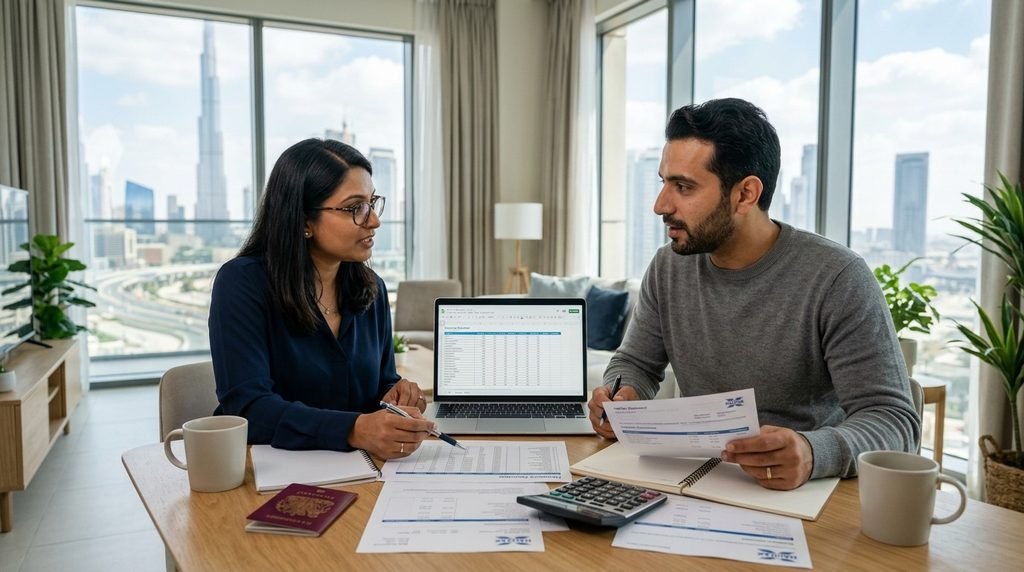
For a new partner or spouse application, the current standard minimum income requirement is £29,000 gross per year. But the number is only the beginning of the analysis: the Immigration Rules specify which income sources can be used, how they can be combined and what evidence must accompany them.
As of 5 September 2026, GOV.UK still states £29,000 for the usual current partner route. Older articles may refer to £18,600 or to proposed future increases, so check the rule in force when you submit. A transitional £18,600 threshold can still apply in certain extension cases where the first partner application was made before 11 April 2024 and the applicant continues with the same partner.
You can review the current GOV.UK financial requirements for partner applications.
A Dubai-Specific Financial Planning Issue
Suppose a British sponsor and their spouse both work in Dubai and intend to return to the UK together.
It would be risky to simply add both UAE salaries together and assume the £29,000 requirement has been met.
For an entry-clearance application, the Immigration Rules allow specified employment or self-employment income of the sponsoring partner, including qualifying overseas employment where that partner is returning to the UK. The rules also contain specific provisions concerning UK employment the returning sponsor will start after returning. The applicant’s own overseas employment salary is not generally treated in the same way as the sponsor’s qualifying overseas employment for entry clearance.
For example, where a sponsor relies on overseas salaried employment and a job they will take up in Britain, the evidence rules require the UK employment to start within three months of the sponsor’s return and contain detailed calculations depending on employment history.
That sounds technical because it is.
Before you submit anything, identify the precise financial category you are relying on and build the evidence around that category—not the other way around.
Can Savings Be Used?
Yes. Specified cash savings can count toward the financial requirement.
Under the current formula, the relevant savings consist of £16,000 plus 2.5 times any shortfall between qualifying annual income and the £29,000 requirement. If qualifying cash savings are being used on their own with no income contribution, that calculation produces £88,500.
Cash savings will normally need to satisfy detailed ownership and evidence requirements. Appendix FM-SE generally requires bank statements showing that the amount relied upon has been held throughout the six months before application, although specific rules exist for situations such as certain investments or proceeds from property sales.
One thing applicants sometimes overlook: a large balance is not automatically qualifying savings. Source, ownership, accessibility and timing matter.
If the sponsor receives certain listed disability or carer benefits, the standard minimum income requirement does not apply in the usual way; an adequate-maintenance assessment applies instead.
English Language Requirement
For a first spouse or partner application, applicants who need to prove English generally need at least CEFR level A1 in speaking and listening through an approved Secure English Language Test, unless they can qualify through an accepted degree or are exempt.
Exemptions can apply, for example, to applicants aged 65 or over, people whose physical or mental condition prevents them from meeting the requirement, and nationals of specified majority English-speaking countries or territories.
The UAE itself is not on GOV.UK’s listed nationality exemptions. Living or working in an English-speaking environment in Dubai therefore does not, by itself, replace the formal requirement.
Check the current GOV.UK English-language rules for family visas before booking a test.
Accommodation Considerations
Applicants on the standard partner route need to show that adequate accommodation will be available in the UK without relying on public funds. Under Appendix FM, accommodation is not considered adequate if it would be overcrowded or would breach public-health regulations.
That does not mean every applicant must own a property.
Depending on the circumstances, relevant evidence might involve a tenancy, ownership documents, confirmation from the person providing accommodation or information establishing who will live at the property. What matters is whether the proposed arrangement meets the rule and can be evidenced.
Documents You May Need
There is no single document pack that fits every spouse-visa application. GOV.UK says the evidence depends on the applicant’s circumstances, and the financial rules in particular prescribe documents for different income types.
A working document checklist may include:
- Identity and immigration documents: current passport or travel document, relevant previous passport pages, and evidence of the sponsor’s British citizenship, settlement or other qualifying status.
- Relationship evidence: marriage or civil-partnership certificate, evidence showing the history of the relationship, joint residence or finances where relevant, travel or communication evidence where the couple has lived apart, and evidence that previous marriages or civil partnerships ended.
- Financial evidence: payslips, matching bank statements, employer letters, savings records, pension or non-employment-income documents, or the more specialised documents required for self-employment and company income.
- Accommodation evidence: documents appropriate to the proposed UK housing arrangement.
- English evidence: an approved test result, qualifying degree evidence or material establishing an exemption.
- Other case-specific documents: information about children, previous immigration applications, criminal convictions where applicable and any other facts requested by the form.
- Translations: GOV.UK requires certified translations for documents that are not in English or Welsh.
- TB certificate where required: the UAE itself is not on the GOV.UK list of countries whose residents automatically require testing, but your recent residence history can change the answer. A person who lived for at least six months in a listed country and was living there within the preceding six months may need a test.
For many couples, the difficult part isn’t finding documents. It is making sure different documents tell the same story.
If the form says you moved to Dubai in March but the relationship timeline says January, or a bank statement uses an unexplained previous address, that does not automatically mean refusal. It does mean the discrepancy deserves attention before submission.
How to Apply for a UK spouse visa from Dubai

The process begins online and normally includes an in-person identity or biometric stage when instructed. A typical application can be planned in eight steps.
- Check the correct immigration route. Confirm that the family visa partner route applies rather than a dependant, fiancé, visitor or another route.
- Check eligibility using the rules in force now. Confirm sponsor status, relationship, financial, English and accommodation requirements.
- Choose the financial evidence route before collecting the final documents. A salaried employee, returning overseas sponsor, self-employed sponsor and savings-based applicant may all need different evidence.
- Prepare and cross-check the evidence. Review names, dates, addresses, employment dates, account balances and relationship timelines for consistency.
- Complete the online application from outside the UK. GOV.UK states that partner applicants applying from overseas must apply online.
- Pay the applicable application fee and Immigration Health Surcharge.
- Complete the required identity and biometric process. GOV.UK says applicants who are required to attend an appointment provide fingerprints and a photograph and take their passport. Use the current GOV.UK visa application centre finder for the UAE rather than assuming an old appointment location remains unchanged.
- Monitor communications and respond if UKVI requests further information. Processing may take longer where additional information or checks are required.
How Long Does It Take?
For a spouse or partner family visa submitted outside the UK, GOV.UK currently says applicants will usually receive a decision within 12 weeks. That is an official processing expectation, not a guaranteed travel date.
If eligible and offered, an applicant can pay £500 for the priority service. GOV.UK currently states that priority family visa applications from outside the UK usually take up to 30 working days. Cases can still take longer if additional information or checks are needed.
In practical terms, avoid organising irreversible travel, employment or housing commitments around the shortest possible decision time.
How Much Does It Cost in 2026?
For an adult applying outside the UK to join a partner, the principal government charges currently include the visa application fee and, for the usual 2-year-9-month spouse/partner grant, the Immigration Health Surcharge.
| Cost | Current Amount Checked 5 Sept 2026 | Planning Note |
| Family visa application outside the UK | £2,064 | Current fee for joining a partner, parent or child |
| Adult IHS for 2 years 9 months | £3,105 | Based on the standard initial partner-visa duration |
| Priority service, if eligible and available | £500 extra | Family visa priority target is usually up to 30 working days outside the UK |
| Other costs | Variable | Translations, English testing, TB testing where required and optional VAC services may add to the budget |
The £2,064 route-to-settlement fee took effect on 8 April 2026. The current family-visa overview also confirms the £3,105 adult health surcharge for a 2-year-9-month period.
Use the current GOV.UK family visa fee information immediately before payment because government fees can change.
Common Problems That Can Complicate an Application
A spouse-visa application can be genuine and still be poorly prepared.
Common practical issues include:
- Using the wrong financial category. Meeting £29,000 mathematically does not help if the income source cannot be relied upon in the way assumed.
- Wrong evidence periods. Employment and savings rules contain specific timing requirements. Documents that are one month too early or incomplete can create an avoidable problem.
- Assuming the Dubai applicant’s salary automatically counts. For an overseas entry-clearance application, the financial rules treat employment income differently depending on who earned it and where.
- Relationship timelines that do not align. Forms, travel records and supporting statements should not contradict one another without explanation.
- Unexplained money movements. If savings are relied upon, source and ownership may need to be documented.
- Outdated English evidence assumptions. Speaking English every day is not necessarily the same as satisfying the formal rule.
- Missing translations. Documents not in English or Welsh require certified translations.
- Treating processing times as guarantees. A 12-week service standard should not become a non-refundable wedding, tenancy or flight deadline.
- Relying on an old spouse-visa article. Fees and immigration rules change. The financial threshold applicable to a new 2026 application should be checked close to submission.
The details can make a difference.
A Practical Pre-Application Checklist
Before pressing “submit,” ask yourselves:
- Are we definitely using the correct family-visa route?
- Does the sponsor have a qualifying UK status?
- Does our relationship evidence cover the relevant history rather than only recent weeks?
- Have we identified the exact financial category we are relying on?
- Do payslips, bank statements and employer letters cover the correct periods?
- If using savings, have we checked ownership, source and holding-period requirements?
- Does the applicant have the correct English evidence or a valid exemption?
- Is our proposed UK accommodation properly evidenced?
- Do dates and addresses agree across the form and documents?
- Have all necessary non-English/Welsh documents been translated?
- Have we checked whether the applicant’s recent residence history creates a TB-test requirement?
- Have we checked the current fee, IHS and processing guidance immediately before applying?
- Have we avoided making non-refundable travel plans based on an estimated decision date?
How Bloom Global Can Help Applicants in Dubai
Bloom Global describes itself as a UK immigration advisory provider serving individuals and businesses pursuing relocation to the United Kingdom. Its website specifically lists the United Arab Emirates alongside Bahrain, Saudi Arabia, Qatar, Oman and Kuwait among the markets it serves.
The company’s published process includes initial consultation and assessment, document preparation and application support, submission and follow-up, and post-visa support.
Applicants who want to understand the company’s wider positioning can review Bloom Global’s UK immigration advisory overview or read more about Bloom Global.
For couples whose financial arrangements, relationship history or document evidence are less straightforward, a pre-submission review can help identify questions that deserve attention. Bloom Global can be contacted to discuss advisory support for a UK spouse visa from Dubai.
Professional assistance does not guarantee approval. The Home Office and UKVI remain responsible for applying the Immigration Rules and deciding the application.
Frequently Asked Questions
Can I apply for a UK spouse visa while living in Dubai?
Yes, if you are living in Dubai and meet the relevant requirements, you can normally make the partner family-visa application from the UAE. Home Office policy says most entry-clearance applications should be made in the country where the applicant is living, and GOV.UK lists the UAE within its visa application-centre system.
Do I need to be a UAE citizen?
No. The UK spouse/partner route is not restricted to UAE citizens. What matters is that you satisfy the UK immigration requirements and are applying from the appropriate country of residence. Your nationality can still affect individual requirements—for example, whether you qualify for an English-language nationality exemption or need TB testing based on residence history.
How much income does my spouse need?
For a typical new spouse or partner application in 2026, the current minimum income requirement is £29,000 gross per year. However, the financial rules are category-specific. An applicant should not assume that every salary or source of household income can be counted. Special provisions also apply to certain benefits and older transitional applications.
Can savings count toward the financial requirement?
Yes. Qualifying cash savings can be used alone or, where the rules permit, with certain other income. The formula generally uses savings above £16,000 and multiplies an income shortfall by 2.5. With no qualifying income at all, the current formula means £88,500 in qualifying savings would be needed. The evidence and holding-period rules must also be satisfied.
How long does a spouse visa application from Dubai take?
GOV.UK currently says an outside-UK spouse or partner application will usually receive a decision within 12 weeks. Where priority service is available and the applicant is eligible, the current outside-UK family-visa priority timeframe is usually up to 30 working days for an additional £500. Neither timeframe is an approval or travel guarantee.
What happens if documents are missing?
The result depends on what is missing and why. The Immigration Rules specify mandatory evidence for some requirements, particularly financial evidence. Appendix FM-SE also gives decision-makers limited scope in certain circumstances to request further or alternative information, but applicants should not assume UKVI will correct an incomplete application for them. Preparing the evidence properly before submission is safer.
Does using an immigration adviser guarantee approval?
No. An immigration adviser or consultancy can assist with preparation, document organisation and understanding the process, but UKVI and the Home Office decide applications under the Immigration Rules. No legitimate advisory service can control the outcome or convert an ineligible application into an eligible one.
Where should I check the latest UK spouse visa rules?
Use GOV.UK and the current Immigration Rules as the primary sources. Check the partner/spouse family-visa page, the financial-requirement guidance, English-language guidance and current fee information close to submission. Rules, fees and service standards can change after an article has been published.
Final Thoughts

A UK spouse visa from Dubai is not simply a marriage certificate plus an online form. The strongest preparation starts by identifying the exact requirements that apply to your circumstances and then gathering evidence designed to prove those requirements.
For many couples, the most valuable exercise is a consistency check: does the financial evidence meet the correct technical category? Do relationship documents cover the right periods? Do addresses, employment dates and travel history agree? Has anything changed since the first checklist was created?
If your circumstances involve overseas employment, self-employment, significant savings, previous refusals, long periods living apart or another less straightforward issue, professional guidance may help you identify questions before the application is submitted. Bloom Global offers UK immigration advisory services from its Dubai base, including consultation, assessment, application-document support and follow-up assistance as described on its website.
Whatever route you take, verify the final application against current GOV.UK guidance before submission. Immigration rules do change, and an accurate September 2026 checklist should never be treated as permanently current.